WeathergagePrivate beta, opening soon

Know what your competitors are building before they announce it.

Weathergage watches your competitors' products the way a patient analyst would. Every week it opens their app, spots what's changed (features in testing, new prices, new integrations, new markets) and sends you a short brief on what it means, with a source for every claim. Not what they announced. What they actually shipped.

Join the waitlistSee how it works

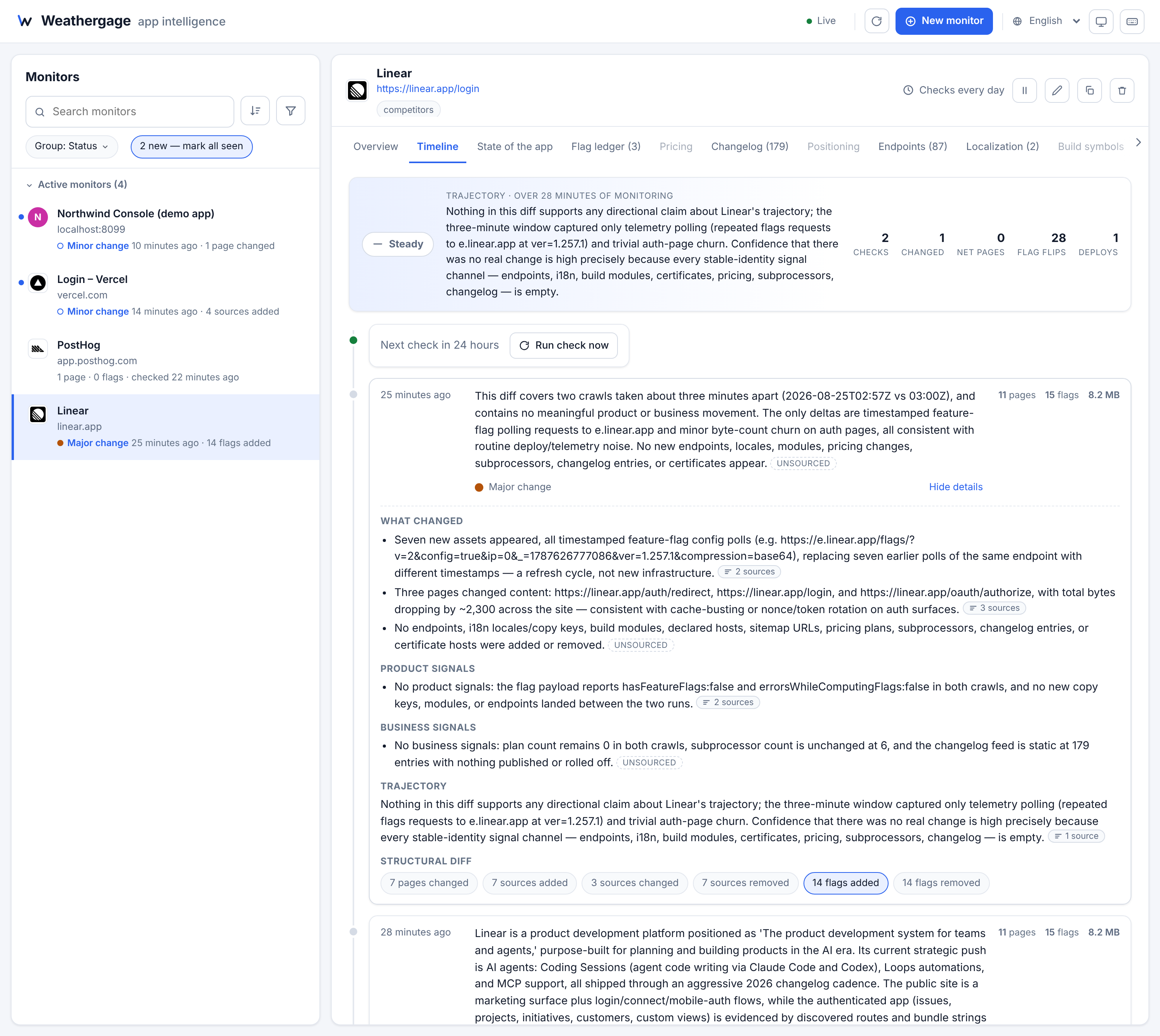
The Weathergage dashboard: a list of monitored apps on the left, each with the grade of its latest change, and on the right the check timeline for Linear with a change's analysis expanded into what changed, product and business signals, and the structural diff behind it
One check on Linear, as the dashboard shows it: what changed, what it signals, and the sources behind each line.

How it works

Point it at an app. Read what changed.

  1. Name the apps to watch

    Give Weathergage the address of a competitor's product. It needs no account and no login: it reads only what any visitor could see.

  2. It checks on a schedule

    Every week (or as often as you like) it opens the app in a real browser, saves a snapshot of the pages and the code behind them, and compares it with the last one.

  3. You get a short brief

    What they shipped, what it means for you, and where they're heading, in a few paragraphs. Every claim names the page or record it came from.

What Weathergage reads, and what you get

  • Their public pages
  • The code behind their app
  • Features turned on quietly
  • Pricing and plans
  • New subdomains they set up
  • Changelogs and blog posts
  • Vendors they disclose
  • Pages they don't link to
  • What they shipped
  • What it means for you
  • Where they're heading

Provenance

Every claim names its source

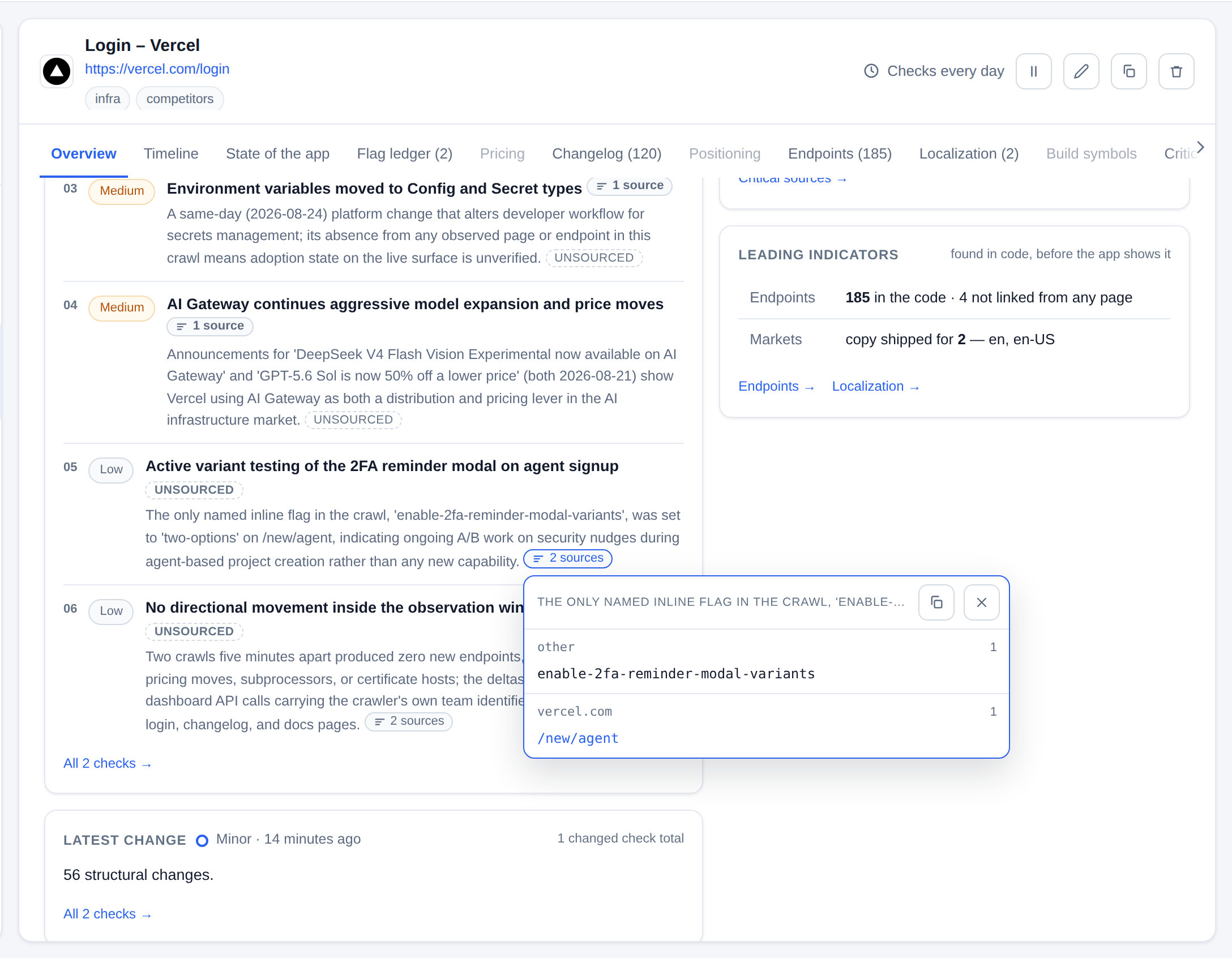
Open any sentence in a brief and see where it was read from: the page, the feature flag, the certificate record, and the date. A claim the check can't back is marked unsourced rather than dressed up, so you know what to trust before you repeat it in a meeting.

A brief about Vercel with one claim, about A/B testing of a 2FA reminder, opened into its sources: the feature flag it was read from and the page that carried it
A claim about Vercel, opened into the flag and the page it was read from.

Flag ledger

Features show up in the code before the launch post

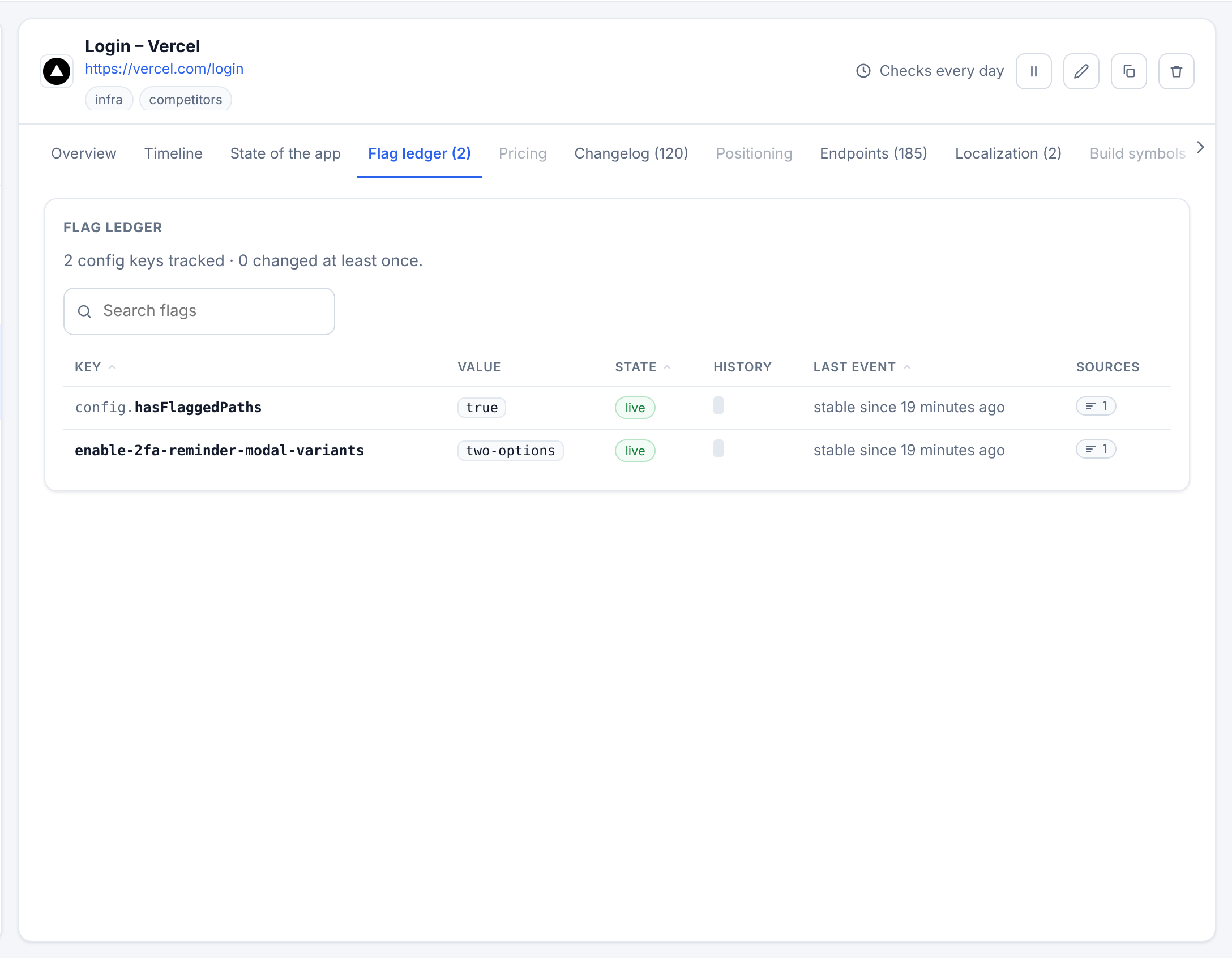
Apps ship new features behind switches, and the switches are in the code weeks before anyone announces them. Weathergage keeps a ledger of every one it sees: its value, whether it's live, and every flip since the first check. A flag that turns on is usually a feature about to launch.

The flag ledger for Vercel: each feature flag's key, its current value, whether it is live, a history strip and when it last changed
Vercel's feature flags, with their values and how long each has been stable.

Positioning trail

See how they describe themselves, word by word

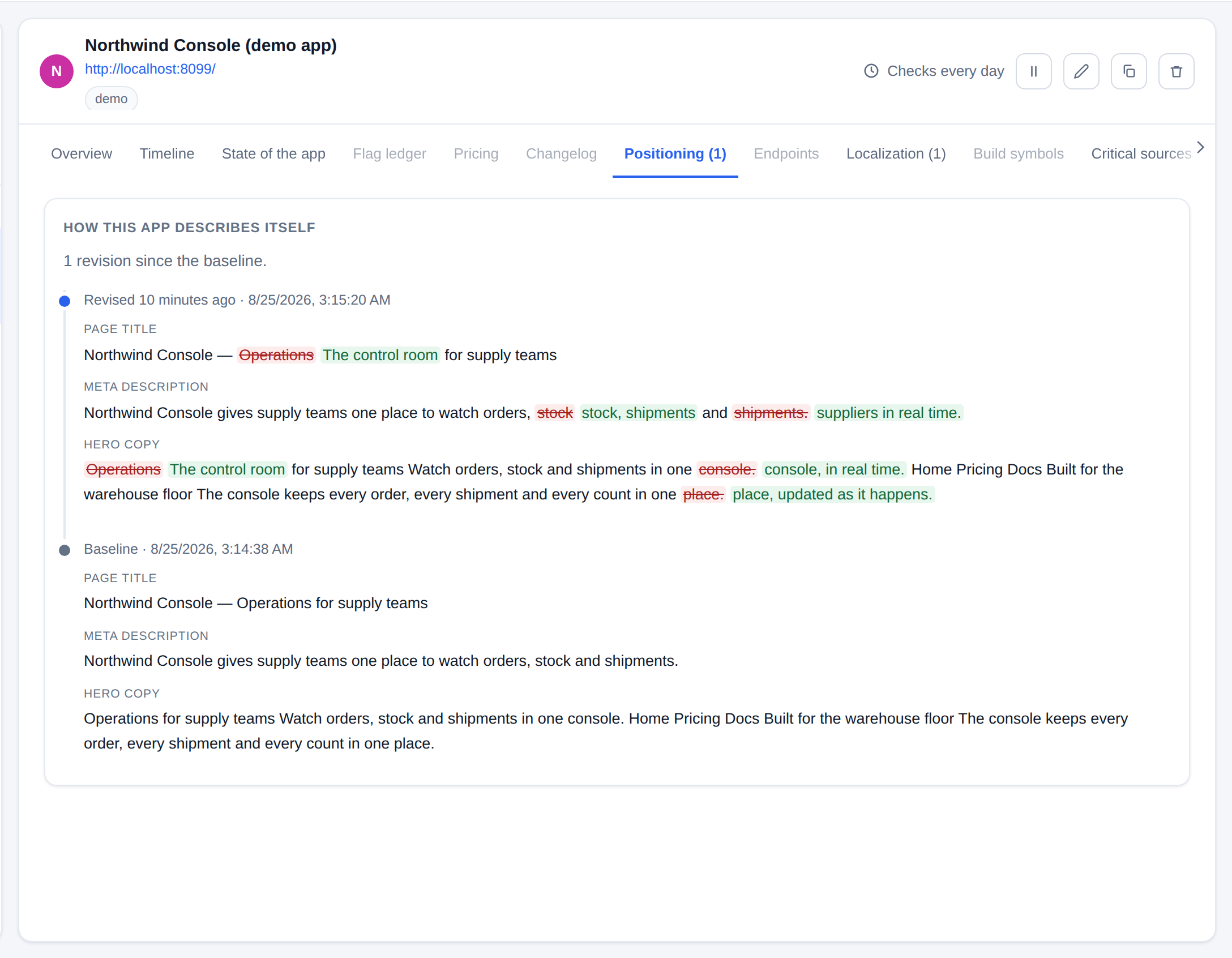
A new tagline, a rewritten pitch, a changed page description: a company tells you where it's going in the words it chooses. Weathergage keeps every revision of the title, the description and the hero copy, with the old and the new side by side, so a quiet repositioning isn't quiet.

The positioning trail for a demo app: its page title, meta description and hero copy, with the words that changed since the last check struck out and the new ones highlighted
A demo app's homepage copy, with the words that changed since the last check marked.

Two things it found

Real reads, from public pages

Found on a page nobody reads

Which AI companies power Linear's new agent features? Linear hasn't said, but the legal page where it lists the vendors it shares data with has: Anthropic, OpenAI and Fireworks AI. Weathergage rereads that page on every check, so you'll know the day a new name shows up.

Linear · checked 25 Aug 2026 · source: Linear's vendor list at trust.linear.app

Counted from public records

Every Productboard customer gets a feedback portal at its own web address, and each address leaves a dated public record. Weathergage counted 84 of them, including 1Password, Epic Games, Unity, Netlify and Zendesk, with 13 added in 2025 and six so far this year. That puts a floor under their customer count and shows how fast it's growing, without asking anyone.

Productboard · checked 11 Sep 2026 · source: public certificate records

Who it's for

Built for the people who have to respond

  • Founders and execsKnow where a rival is heading before the board asks.
  • Product teamsSee what competitors are testing, not just what they've launched.
  • Marketing and salesRespond the day a rival changes a price or puts up a new page.
  • Investors and analystsFollow a market from what its companies actually ship.

Join the waitlist

We're starting with a small group. Leave your email and we'll let you know when it's your turn.

By joining, you agree to hear from Weathergage about the beta and the launch. We'll confirm your address by email before we send you anything else, and every email has an unsubscribe link.

Questions

What is Weathergage?

Weathergage is competitive intelligence for web apps. You tell it which products to watch, and every week it opens each one in a real browser, compares it with the last check, and sends you a short brief on what changed and what it means, with a source for every claim.

How does Weathergage find things a company hasn't announced?

Weathergage reads what a product actually serves, not what the company says about it: the pages and the JavaScript behind them, features quietly switched on behind flags, pricing and plans, new subdomains that show up in public certificate records, the vendors listed on legal pages, and changelogs and feeds. These change when the work ships, which is usually well before the announcement.

How often does Weathergage check?

Weathergage checks each product once a week by default, and you can set a different interval for any of them. Each check is compared with the one before, so you read what changed instead of a fresh description of the same app.

Where does each claim come from?

Every claim in a Weathergage brief names the page or record it came from and the date it was read, and the snapshot behind it is kept. You can check any sentence against its source instead of taking it on trust.

Does Weathergage need access to a competitor's product?

No. Weathergage only reads what a product shows the public: no account, no login, nothing behind a paywall, nothing an ordinary visitor couldn't see. What it adds is patience and memory: the same check every week, compared with every check before it.

Who is Weathergage for?

Weathergage is for founders and execs who need to know where a rival is heading, product teams keeping track of what competitors are testing, marketing and sales teams who have to respond the day a rival puts up a new page, and investors and analysts following a market.

How do I get access to Weathergage?

Weathergage is in private beta, starting with a small group. Join the waitlist on this page and we'll let you know when it's your turn. You'll get one email to confirm your address, and nothing else until you click the link in it.